WOMEN OF THE HEBRIDES
A Legacy of Strength
The women of the Hebrides were forged from the strongest stock, born into a life where resilience was not a choice, but a means of survival. Raised in the demanding croft environment, their training in hard labour began the moment they were old enough to carry a heavy pail of water from the well. This upbringing in often impoverished circumstances did not break them; instead, it built rare physical toughness and deep inner strength.

They were the silent engines of the island economy, seamlessly bridging the gap between the land and the sea. Whether cultivating the rugged soil, gutting the herring on the piers, or maintaining the steady rhythm of the loom, these women underpinned the very foundations of the agriculture, fishing, and Harris Tweed industries across the islands. Without their relentless effort and commitment the Hebrides would never have flourished, leaving a legacy of endurance that remains etched into the island landscape.

Every Hebridean doll is a tribute to the women of the Outer Hebrides whose resilience defined a landscape. To hold one of these dolls is to hold a piece of a legacy forged in the remote Hebridean communities of the wild Atlantic coast.
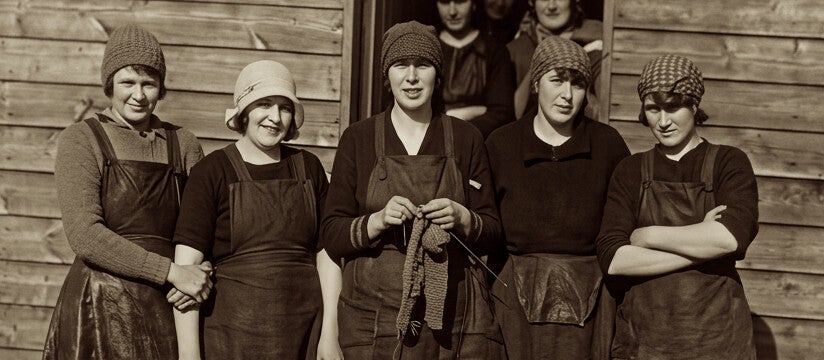
- HERRING GIRLS -
The story of the Hebridean ‘herring girls’ is a testament to the grit, skill, and communal spirit of the women from the Outer Hebrides. During the peak of the herring industry in the 19th and early 20th centuries, these women left their crofts to follow the herring as they migrated along the coast from Wick in the North of Scotland down to Yarmouth in East Anglia.

These women worked in highly efficient crews of three: two gutters and one packer. Their workday began at the break of dawn, usually around 6:00 AM, and could stretch until 10:00 PM or even midnight during the peak summer months. They worked every day except Sunday, often standing in open air through rain, sleet, and snow. Despite the physical toll, the work offered these women a rare degree of financial independence and social freedom. They were paid by the barrel, and their earnings were often vital for supporting their families back home.

Between shifts, the air would be filled with the sound of Gaelic songs and laughter, as the ‘herring girls’ maintained a fierce sense of companionship that defined an era of maritime history.
The herring industry was severely crippled by the First and Second World Wars, and it never managed a full recovery. By the late 1940s, the gutters' knives were silenced as mechanisation replaced the manual labour that had defined the Hebridean coastal life for generations.
- THE WOMEN OF THE LAND -
The Hebridean landscape is a living map of endurance with its rolling moors and rugged hills bearing the ‘scars’ of human cultivation that have been carved over the centuries of toil. The Hebrides was a world of absolute self-sufficiency where the turn of the seasons dictated a relentless cycle of labour.

In the summer months, with the men away at sea for the fishing season, the weight of the land fell almost entirely upon the women. Their days were a marathon of agricultural duties which would include peat cutting, caring for their livestock, milking the cow, milling the grain, preparing food for the bleak winter months, preparing wool for the spinning wheel, and looking after their children. In the years of scarcity, they harvested everything nature provided to sustain life. This marginal existence was the foundation upon which their resilience, strength and resourcefulness became embedded into the very fabric of their being.

These women were never still; even when not at the loom or in the croft, they knitted continuously, producing socks and jumpers to meet both family needs and eventually the growing demand for ‘island-made’ goods.
As the years progressed, the nature of the croft began to change where the domestic struggle for survival gradually shifted, as modernisation increased, the need for self-reliance was reduced. The domestic struggle for survival began to shift from necessity of the home to a sought after commodity.

- WEAVERS and WAULKERS -
While the ‘herring girls’ dominated the coast, another revolution was unfolding within the thick stone walls of the Hebridean crofts. Starting in the mid-1800s, women took up the loom, transforming what was once a quiet domestic chore into a cornerstone of the Scottish economy.
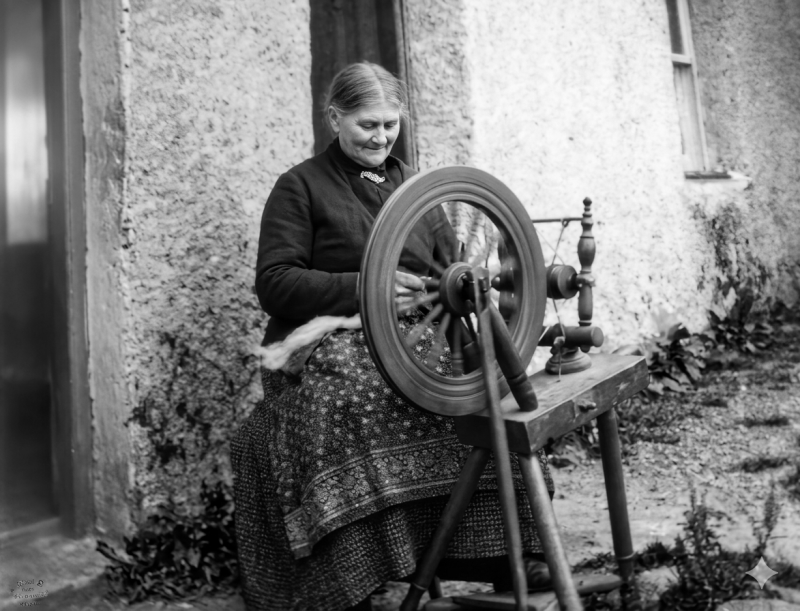
Originally, homespun tweed was crafted for domestic use with heavy, warm garments being made to protect the family from the Atlantic gales. However, by the mid-19th century, the exceptional quality of this fabric caught the eye of the world, and what was once a survival skill became a vital commercial enterprise.
The vibrant colors of the landscape were literally woven into the cloth. Hebridean women were master colorists, venturing out to the moors and hills to collect heather and lichen scraped from the rocks and plucked from the hills, and also local flora, which would be boiled in large pots with the wool to create the signature colours of the Hebrides.
The most distinctive part of the weaving process was the ‘waulking’ of the cloth where groups of women would sit around a long wooden table, rhythmically beating and shrinking the wet tweed to thicken it. To keep the pace and pass the long hours, they sang Gaelic waulking songs.
By the time the industry formalised into what we now know as Harris Tweed, it was the skill and endurance of these women - who balanced the loom with child rearing and tending to the many duties of the land - that had secured the fabric’s reputation. Much like the herring girls, the weavers were the unsung architects of Hebridean independence, turning the resources of their rugged landscape into a world-renowned treasure.

All historical images are reproduced with kind permission.
©Comann Eachdraidh Chàrlabhaigh: Herring girls, women standing outside their homes, woman milking her cow, and women at the peats.
©Comann Eachdraidh Cheann a' Loch: Woman tending to the hay, spinning yarn, and working with tweed.